In the 18th century the ‘Enlightenment’ era was bursting with new ideas and ways of life. Men like John Locke, Isaac Newton, and Bernard de Fontenelle discovered the scientific method. This is to see the world through empirical means and make an educated hypothesis on how it functions based on the evidence collected. Rational thought declared that all men should have equal rights and that everyone deserves to live. An artist that embodied this desire for knowledge was Joseph Wright of Derby. The artwork that I will be discussing is The Alchymist.
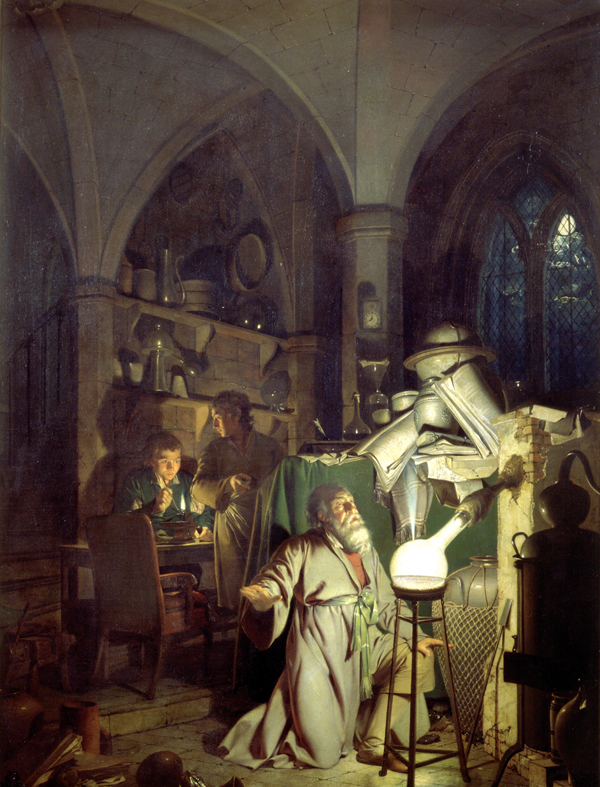
Joseph Wright of Derby was a man who was fascinated by machinery and science. Living during the Industrial Revolution he had many opportunities to meet many intellectuals, artists, and philosophers. His love for science eventually reached his love for painting. In the painting The Alchymist, it shows a scientist doing an experiment in what seems like a gothic like church. He is in awe of what he has discovered. It is believed that the man is Henning Brandt and his discovery of Phosphorus. Like the Gothic Church, there seems to be other religious connotations in the painting, such as the scientist bending on his knee in a religious fashion. The Derby Museum describes his kneeling position as the referencing of St Francis receiving the stigmata or St Jerome in prayer.
Joseph Wright of Derby also uses the effect of chiaroscuro in his paintings. This is apparent in The Alchymist. The glass orb that the scientist is experimenting on has a very bright glow to it giving the surrounding room a calm glow. Wright was fascinated with the effects of light on objects and people so in many of his painting one can see a large source of light illuminating a room full of objects and people. Although the painting seems very magical, 18th century critiques at the time of its creation were seen very uncomfortably. The religious and scientific subject matter puzzled many viewers and it toke almost four years for Wright to sell his work. Some historians believe that the painting was to celebrate the wonders of scientific discovery, some thought it was the message of science explaining religious questions, or that the painting helps vindicate chemistry from the past associations it had with alchemy. Whatever its real purpose it is a very compelling piece. Wright’s painting plays with such concepts as knowledge and enlightenment, theory and practice, spectatorship and discovery, temporality and historicity, and the local and national to suggest a type of enlightenment.
The Alchymist did not gain as much recognition as An Experiment on a bird in the air-pump or The Orrery, but it seems to have a more puzzling characteristic about it that makes some art historians question the purpose of the painting. One historian concludes that the painting is to turn the roles of demonstrator, discoverer, and spectator around from any rational point of view. The scientist is as much the discoverer as the demonstrator, he is watching the phosphorus created with his assistants and he is also a spectator, as he accidentally discovered the element. His expression gives off the impression that he has no rational explanation for the phenomenon. In the Enlightenment age this would be seen as troublesome because rationality was the only way to make way for reason. In science usually the scientist is fully aware of his workings and his surrounding, so to see this on a painting confused many. I believe that Wright was trying to promote science in a different way, so as to make the viewer have a scientific and analytical view of his painting.
References:

This painting does have an interesting combination of both science and religion. I mentioned in lecture how the Enlightenment was fostered by an emphasis on reason and science (which consequently deemphasized religion). It's interesting to see how Joseph Wright of Derby seems to be elevating science in a cathedral-like space (perhaps suggesting that science is the "new religion" of the day?).
ReplyDelete-Prof. Bowen
This is a very interesting painting. I like that it is a meeting of the worlds, in a way. The connection between science and religion is very intriguing and quite possibly one of the first examples of it.. Thanks for bring this painting to my awareness.
ReplyDeleteI think it is very interesting that no one knows the exact purpose for the creation of this painting. I think that adds a great amount of mystery and intrigue. At first glance I would have never picked up on the religious aspects, but now I can definitely see that he looks like he could be in a gothic like church.
ReplyDeleteI agree that this painting brings up some very interesting points and your comments on it are thought provoking. As someone else mentioned the arched Gothic columns of a cathedral and chiaroscuro lighting almost suggests a religious event. Is the artist saying that we can become enlightened through science much as we can through religion? Is the search for truth the same as the search for God?
ReplyDeleteThe amazement of the subject at his findings might also represent his astonishment of empirical research actually producing verifiable results. Imagine what it must have felt like discovering the sounds emanating from a radio even though you knew that radio waves existed.
The play of light within this work caught my eye as I entered the page. Especially with the dark background of the webpage. While I quickly picked up the focus on the foreground figure with the alchemy, the two figures also have their own highlight from the overall piece. The fact that it was a paint mired in some controversy is to be expected, but I find it a very fascinating piece.
ReplyDelete