Tuesday, April 3, 2012

Realism and Early Avant-garde

            By the middle 1800’s, the Industrial Revolution was increasing at an unprecedented rate all over Europe and the United States. Many machines that required energy and a solid structure increased the demand for coal and iron. Many of the rural populations moved to the newly formed urban societies to hopefully work in the factories and industrial plants. Thus the middle class was born, also known as the bourgeoisie. While the factories provided work, the conditions in the factories and mines were unsanitary and unhealthy. Many of the workers subject to these working conditions were women and children, which forced the government to create regulations to have a safer workplace. Although the regulations helped the factory workers to a certain degree, some socialist thinkers shunned the capitalistic exploitation of the workers for maximum profit. Men like Karl Marx and Friedrich Engels argued against the economic structure of capitalism and prophesized the eventual demise of the bourgeoisie to the proletariat, or the working class. In the art world the same movement was taking forth.
In France, the Academie des Beaux-Arts was considered the highest influence over what styles of art was the most significant. Many of the art works were historic paintings and depicted the struggles and journeys of heroic and important men. Then in 1831, an architect named Eugene Viollet-le-Duc brought the idea of avant-gardism to the art world. Avant-garde artists thought their work to be in advance of the current artwork at the time and would reflect the ideas of socialism. Viollet-le-Duc gathered a few independent artists to create art that was against the Academie Beaux- Art. He wanted artists to create controversy and new political and social ideas. From this came Realism, the depiction of life in the real and natural world. Many of the independent artists depicted the urban lower class in their daily activities. The art was not to celebrate a historic moment or commemorate an important figure; the art was simply to show the reality of the modern world. An artist that conveyed this was Gustave Courbet in his work of the Stone Breakers.
At the time the Stone Breakers was looked down upon by the bourgeoisie. The piece looks very innocent and simple from a certain perspective, but upon further examination the piece conveys ideas of socialism and the flawed social class of the bourgeoisie. In the Stone Breakers two men are in their occupation breaking stones for road gravel. At the time, this was considered the lowest type of work, so this piece automatically receives negative attention from the bourgeoisie as it does not portray a historic moment and being in a large scale it should have portrayed something historical. One of the men is old while the other is young; they are both faceless, purposely done this way to show the unimportance of the men. This was another detail that was frowned upon the bourgeoisie because their styles of art called for figures of grand importance and with recognizable faces. Courbet then pictured the men in pheasant-like clothing; the younger one in more modernized attire, making a political statement that the new generation will have a grim future in a capitalistic system. This was far from the styles the bourgeoisie promoted in their artwork. Many of their artworks promoted the wealth and prestige of individuals, and emphasized the importance of an intellectual and ambitious mind. Courbet fought against this by picturing a scene with two poor male figures of unimportant background with little to no education, working in the lowest of society’s occupations. By doing this, Courbet in a way made these anonymous men into some kind of heroes, which was far from the hero the bourgeoisie conveyed in their art. The composition of the piece and the use of color further carry the piece closer to realism. The figures are juxtaposed in awkward positions and the colors used for the piece are dark gloomy and give a feeling of exhaustion. Courbet was intent on creating a piece that was a real as possible to give the viewer no indication that this was a dramatized scene in history like in the bourgeoisie art. The viewer is to see the harsh reality of the lower class and the exploitation they are subjected to by the bourgeoisie. 

Thursday, March 29, 2012

Intro to Avant-garde

            When I think of ‘avant-garde’. I think of Italian Vogue or something that exhumes high fashion or gaudiness. I believe that today the word avant-garde is used to characteristic art that is very unconventional and experimental. The art is not supposed to be logical or rational; it can be in films, music, sculpture, paintings and any other mediums. For example when I look into Italian Vogue and see the wardrobes the women are wearing I am perplexed. I am perplexed because although the clothes have deep rich colors and have a variety of textures, the clothing itself is not practical. The shoes would be enormous or the coat would be too large and long for the person, but this is what characterizes avant-garde. The wardrobe is not supposed to be for practical reason or be worn outside of a runway, the clothes is created purely out of the innovation and imagination of the designer. The art is supposed to be about the art, to focus on the details and overall compositions to the piece, so as to make the viewer ask why combine those different elements. An example of avant-garde art would be Manet’s Luncheon on the grass.
            Before obviously looking at the naked woman, the scene seems serene and relaxing. Two men are enjoying their conversation and a woman is wading in the water at the background. Then when your gaze has come across the entire painting you are pulled to see the naked woman. She is emphasized by the paleness in her skin, forcing the viewer to direct your eyes towards her. Once one sees her the whole painting loses all logic and narrative. Her pose is very relaxed and her gaze is directed towards the viewer as if he or she was included in the painting. Avant-garde focused on the innovative and unconventional and Manet’s painting achieved this. Back in the time that it was created nudes were highly appreciated by the art galleries, but the nude characteristics had to depict historical or mythical scenes, with women usually in a provocative or sensual pose. Manet challenged this stereotype of the nude female to draw a female that is shown nude, but is not showing any of her indecencies. She is very relaxed and has the energy that she belongs there. Aside from her the scene combines further objects and figures and convey avant-garde. The men are in conversation as if she was fully dressed. The men have no shocked faces upon them and the woman is not embarrassed about her state.
            What shocks the viewer the most though is her gaze, she looks at the viewer in a very calm expression. She is not exhibiting any sexual energy, so it seems awkward as to why she would be present in the scene. Manet captured this scene to be innovative, to go outside the box and push the limits of what art is and how society views it at the time. There is no clear indication to what is the background since the woman in the water is not scaled in proportion to the figures in the foreground. The scenery seems to be man-made and some of the objects look as if the artist was quickly painting it. The food scattered upon the floor in the foreground is random and appears unimportant. All these elements further challenge the viewer to make some sense of the painting. Manet was trying to create an art piece for the sake of art. He intended his brushstrokes to be very random and transparent to give his technique away to the viewer and the unconventionalism of the objects and figures further heightens the feeling of avant-garde. Much like the clothing in the high fashion magazines, the clothing is not to be seen as a wearable clothing, but as a unifying composition that asks the viewer what art is.

Monday, March 5, 2012

Final post

            I was very excited about this class because we would be touching upon the Renaissance and Enlightenment period. I am very drawn the Renaissance and Enlightenment period because I am supporter of science and reform. I also believe in being the best human being you can be and a way of achieving this is to be a rational and logical human being. In the middle ages many of the lower class was enslaved into the feudal system therefore had little time to create and imagine. Once the Renaissance period came, many travelers, merchants, and inventors were sharing their findings and spreading new ideas. The corruption of the Church led people to find their own meaning from the Bible and scientist were changing the very fabric of what humanity was. In the Enlightenment era many scientists and philosophers were again challenging the power of the Church through pure reason to create a more perfect society. Art was used as a sort of propaganda for the times to send messages across to the people and spread ideas. What I really like about the class though that although the class did touch upon my favorite times in history it brought forth artists I never looked into and made me appreciate the eras I love.
            What intrigued me most about the Renaissance and the Enlightenment era was the push to create the illusion of reality as much as possible. So humanism, realism, and idealism dominated these periods in various ways. Renaissance period artwork such as Michelangelo’s Moses combines all the stylistics characteristics of humanism, idealism, and realism. Moses is shown in perfect proportions following the canon of proportions of Polykleitos. His body is idealized, showing very muscular arms and the indication of sturdy powerful legs and the tablets in his arms show human achievement of how Moses was able to communicate with God and receive his laws upon humanity. I was fascinated by both the visual details of the piece and the historical context. I like realism and idealism, so Michelangelo’s Moses fits well into my spectrum of ideas. The polished look on his body compliments the skill of the drapery Michelangelo used to achieve the look of clothing.
In the late Eighteenth century during the Enlightenment period in France Louie XVI was in power and was sympathetic to the Enlightenment movement. His commission of Oath of the Horatii by Jacques-Louis David is another example of artwork that incorporates realism, idealism, and humanism. Humanism is depicted by the subject matter and message of the artwork. The three young men on the left are giving oath to their father while the women on the right are weeping for the men who are going to commit to the army. The men’s and women’s bodies are proportioned accurately, the architecture is sound and the use of value reflects the characteristic of realism. Idealism is shown in the subject matter and in the bodies of the men. The subject matter shows the men honorably giving their lives for the cause, while the father is so overwhelmed by their determination that it seems he is taken aback. The men’s bodies appear very masculine and strong, while the women are slim and supple. The painting seems to have a balance of the masculine with the feminine which gives the painting even further interests. The paining was revered so highly in France that it eventually became a message of self-sacrifice and patriotism. The ideas of the paining led men of the French Republic to overthrow the French monarchy and establish a republican democratic government.
The Renaissance Period and the Age of Enlightenment were times were ideas were plentiful and society was looking to improve itself. Artworks such as Michelangelo’s Moses and Jacques-Louis David’s Oath of the Horatii inspired men to mold society to an ideal and humanistic society. To reach the level of perfection that only their ancestors would have dreamed of. Along with science and philosophy, art has paved and is still paving a new way of thinking in human society.On a side note the class also made me appreciate Baroque art!

Tuesday, February 28, 2012

18th Century art


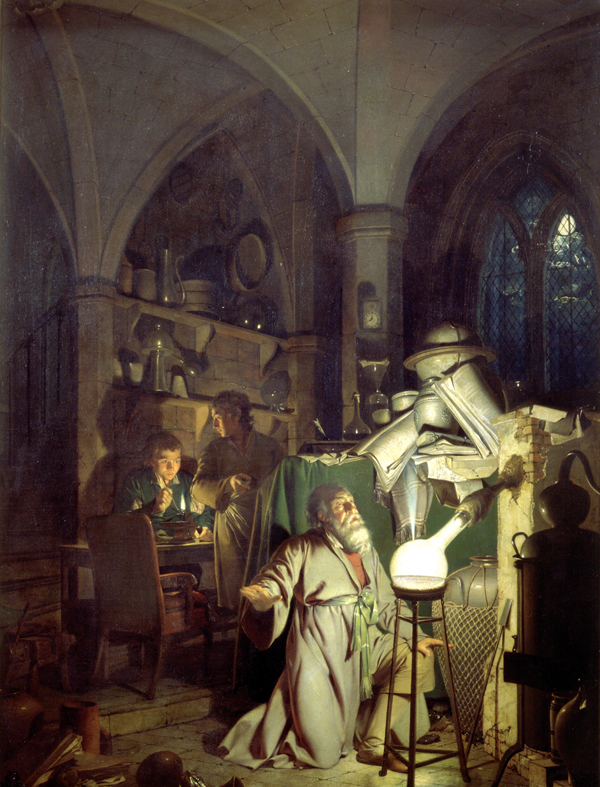
In the 18th century the ‘Enlightenment’ era was bursting with new ideas and ways of life. Men like John Locke, Isaac Newton, and Bernard de Fontenelle discovered the scientific method. This is to see the world through empirical means and make an educated hypothesis on how it functions based on the evidence collected. Rational thought declared that all men should have equal rights and that everyone deserves to live. An artist that embodied this desire for knowledge was Joseph Wright of Derby. The artwork that I will be discussing is The Alchymist.
            Joseph Wright of Derby was a man who was fascinated by machinery and science. Living during the Industrial Revolution he had many opportunities to meet many intellectuals, artists, and philosophers. His love for science eventually reached his love for painting. In the painting The Alchymist, it shows a scientist doing an experiment in what seems like a gothic like church. He is in awe of what he has discovered. It is believed that the man is Henning Brandt and his discovery of Phosphorus. Like the Gothic Church, there seems to be other religious connotations in the painting, such as the scientist bending on his knee in a religious fashion. The Derby Museum describes his kneeling position as the referencing of St Francis receiving the stigmata or St Jerome in prayer.
            Joseph Wright of Derby also uses the effect of chiaroscuro in his paintings. This is apparent in The Alchymist. The glass orb that the scientist is experimenting on has a very bright glow to it giving the surrounding room a calm glow. Wright was fascinated with the effects of light on objects and people so in many of his painting one can see a large source of light illuminating a room full of objects and people. Although the painting seems very magical, 18th century critiques at the time of its creation were seen very uncomfortably. The religious and scientific subject matter puzzled many viewers and it toke almost four years for Wright to sell his work. Some historians believe that the painting was to celebrate the wonders of scientific discovery, some thought it was the message of science explaining religious questions, or that the painting helps vindicate chemistry from the past associations it had with alchemy. Whatever its real purpose it is a very compelling piece. Wright’s painting plays with such concepts as knowledge and enlightenment, theory and practice, spectatorship and discovery, temporality and historicity, and the local and national to suggest a type of enlightenment.
            The Alchymist did not gain as much recognition as An Experiment on a bird in the air-pump or The Orrery, but it seems to have a more puzzling characteristic about it that makes some art historians question the purpose of the painting. One historian concludes that the painting is to turn the roles of demonstrator, discoverer, and spectator around from any rational point of view. The scientist is as much the discoverer as the demonstrator, he is watching the phosphorus created with his assistants and he is also a spectator, as he accidentally discovered the element. His expression gives off the impression that he has no rational explanation for the phenomenon. In the Enlightenment age this would be seen as troublesome because rationality was the only way to make way for reason. In science usually the scientist is fully aware of his workings and his surrounding, so to see this on a painting confused many. I believe that Wright was trying to promote science in a different way, so as to make the viewer have a scientific and analytical view of his painting.
References:

Wednesday, February 22, 2012

Baroque Art

            During the fifteenth and sixteenth centuries the Renaissance and the Reformation society was growing accustomed to change in the religious world as well as the scientific one. The shattering of the Roman Catholic Church brought many people to interpret the Bible their own way and led many like Martin Luther to a new way of approaching Christianity. Protestantism came forth in many versions and many artists now had opportunities to seek patrons not only in religious sects, but in secular ones as well. As time approached to the seventeenth century, many of the landscapes changed to the new majority of Protestants. Most of Northern Europe converted to Protestantism and Southern Europe clung to Catholicism. Science also changed the perception of the world, now that the knowledge that the world was not the center of the universe had come out, many saw that world around them was much more complicated. From all this change came the style of art called Baroque. Baroque incorporated and rejected many of the ideals of the Renaissance. Humanism was incorporated into the art in the Baroque period by portraying humans in different everyday activities, not only that but unlike the Renaissance artists the Baroque artists conveyed the humans in more emotional aspects. Unlike the Baroque period, Idealism was the dominant style in art during the Renaissance. Many of the Renaissance artists valued idealism and this left the viewers of the art to only observe the art not interact with it. Baroque art was the exact opposite, the artists emphasized movement, emotion, and energy to incorporate the viewer to interact with the piece. Naturalism also was incorporated in the Baroque period, but unlike the Renaissance the artists wanted to portray nature in a more emotive way. Still life’s and genre paintings depicted everyday objects and scenes so the viewer can relate to the piece and is more inclined to be responsive to the piece. Visual Harmony was used in a more dynamic and interactive way during the Baroque period as well. Instead of the usual pyramidal composition or symmetrical composition, many Baroque artists utilized asymmetrical balance to establish their compositions. This made the pieced much more interesting to look at and receive a greater emotive reaction from the viewer.
            Bernini’s David and Michelangelo’s David share some similarities in artistic style, but unlike Michelangelo’s Renaissance David, Bernini’s Baroque David has some different styles that pay homage to the Baroque period. Bernini’s David shares the ideals of humanism, naturalism, and idealism with Michelangelo’s David. For humanism, both pieces share the promotion of human achievement; they both wish to convey the best of the human being and portray the human body reminiscent of the ancient Greeks and Romans. The difference between Bernini’s David and Michelangelo’s David was Bernini’s David was a much more humanistic David, Michelangelo’s David is more idealistic. Bernini portrays David in movement, his body twisting as he is ready to launch the rock at Goliath. The viewer is forced to interact with the piece, to envision what is to come next. Michelangelo’s on the other hand is very stable, calm, and resolved. His David looks like he is contemplating the situation, so this leads the viewer only to think in an unemotional way. Both Davids exhibit the ideal of idealism though with the musculature of David although, Bernini’s David is much more mature and built. Bernini’s David shows tension in his muscles, unlike Michelangelo’s. Since Bernini’s David and Michelangelo’s David have similar visions of the human body, I can say that both the periods of the Renaissance and the Baroque periods had a similar style in naturalism. Both periods wanted to show the world in empirical means, but the Baroque wanted a more emotive response to how the world should be looked at. Renaissance art only showed an idealistic look at the natural world, so the viewer could not connect with the piece. In the Bernini’s David naturalism is shown by the way David would actually react to the action at the time. Michelangelo’s David looks more like hes walking on runway showing off his greatness. Bernini’s David is crouched, ready to attack his opponent in a serious and determined manner. Lastly, visual harmony in Bernini’s David is different that Michelangelo’s David by the way it is juxtaposed. Michelangelo’s David is in a balanced weighted pose that was popular in the Renaissance period. Called the Canon of Polykleitos, many of the sculptures at the Renaissance time had a proportionate body in a balanced posed. The body was commonly in an ‘S’ shape with one of the legs weighted against the other. Michelangelo’s David copies these canons of proportions and so does Bernini, but Bernini’s goes away from some of the traditions. For instance, Bernini’s David is proportioned correctly, but his body is not balanced in an upright symmetrical way. Bernini’s David is twisting in different directions implying asymmetrical balance. By doing this Bernini’s David exhumes more energy and movement. Visual harmony is still reached, but Baroque art molds visual harmony with the emotive senses to convey a more stimulating experience.

Wednesday, February 8, 2012

16th Century art in Northern Europe

In 1517 Martin Luther, a former catholic priest, wrote the 95 Theses stating the Reformation of the Church. Many people were tired of the rich and lavish lifestyles the clergy of the Roman Catholic Church was living while many of the people were starving. Men such as Martin Luther proposed to learn about Christianity through individual means, to seek God not through the Pope, but through the Bible. What helped evolve Reformation was the invention of the printing press, the printing press helped distribute ideas and debates of how religion should be followed. As well as the translation of the Bible to vernacular Italian or other languages helped the common people who could read better understand for themselves of what the meanings of the Bible are. As the Church was losing its influence on the people many Catholic artists had to move to other countries to find patronage to pay for their art. Also many artists made their own interpretation of the religious texts and decided to portray religious art more humanized. Art was no longer important in the religious realm; so many artists started depicted self-portraits, secular (non religious) objects, still lives, landscapes, and more humanized humans.
            The types of subject matter at that time that was sought after were usually self-portraits or paintings of scenery. A sort of Capitalistic system was starting to burgeon in Northern Europe, many men started to acquire wealth through selling commodities and other business like affairs, unlike the past way of inheriting wealth. As these men started to build their wealth many wanted to decorate their homes with furnishings and art. Individualism was taking place across the Northern European land, so many wanted artists to paint themselves in self- portraits to embody themselves in a grandeur style. Religious art was still made, but many artists started to make their own interpretations of religious scenes. For example in the Engraving of Adam and Eve by Albrecht Durer there is still a presence of religious subject matter that was popular in Catholic art. The differences are that Catholic art was more focused on the subject matter, the message, than the art itself. Durer went away from this and combined the immaculate detail of the Northern Renaissance to the religious theme of the piece. As one can see the background is very detailed, the foliage of the leaves, the array of bark markings on the tree, the feathers of the bird, the cliffs in the background, the animals around the forest and the humans themselves. Durer went away from the Catholic human form to the Classical representation of the human body. Durer made an ideal depiction of Adam and Eve, giving them appropriate proportions and well presentation of human anatomy.
Although Durer was immaculate in his detail, he still tried to include symbolism in his art to pay homage to the Catholic art. In the engraving Durer tried to emphasize the fall of man and his weakness. The animals portrayed in the engraving all have symbolic meaning to the weaknesses of man. The text Art History describes the symbolism as the stubbornly elk, the choleric cat, the phlegmatic ox, the sensual rabbit, and the mouse a symbol of Satan. Durer was able to mold both the past artistic trends of the Catholic art of subject matter and religious theme, and the future, of including fine detail and proportionate human beings.

Tuesday, January 31, 2012

Mannerism

            Mannerism was the movement after the death of Raphael. Many wanted to get away from High Classical idealism and realism. Through elegance, grace, and artificiality artist departed from past artistic conventions such as balance and lifelike references. Many of the art created during this time referenced past High Renaissance art, but unlike the High Renaissance art the humans were disproportioned and the background and subject matter for the pieces usually left someone scratching their head. Examples of mannerism are Parmigianino’s Madonna with the Long Neck and Bronzino’s Allegory with Venus and Cupid.
            As I said before the Mannerist style portrayed the human form in disproportioned and anatomically incorrect positions. Madonna with the Long Neck is a good example, as the title suggest, the Madonna’s neck is exaggerated to a length not normal. Her body proportions are incorrect as well; her legs are thick and long compared to her small and thin shoulders. Her hands are too long for a female and her body is in an unbalanced position holding Christ. The baby is also anatomically incorrect, the baby is much too large and long to be a child, and his arms are at awkward positions giving the impression of no balance. Anatomical awkwardness is also shown in Allegory with Venus and Cupid. Cupid is seductively holding Venus in an awkward anatomically impossible position. Cupid’s back is curved to a point unimaginable and the angles at where his legs are bent at have no reinforcement to his pose.
            Another Mannerist style is the use of background, with the Classical period background was used for the basis of foundation, to set the setting and establish order and balance. Mannerism deterred from that conveyed the background as more of an abstract idea. In the Madonna with the Long Neck the background has a small man unrolling a scroll, the way he is positioned seems that the artist was not pressed to worry about perspective. As the image of the unsupportive column suggest as well. The column is gigantic in proportion to the small man, so this takes away at what depth there is to the picture and if there is linear perspective. In the Allegory with Venus and Cupid the background is very random and gives off the impression as being tight and cramped. There is much movement in the background distracting the viewer from Venus and Cupid. Not only that but, there is no sense of where the light is coming from. The lighted figures are in random places and the lady on the left top corner should be lighted as she is at the same distance as the man in the right top corner.
            Although both artworks are Mannerist I feel the Allegory withVenus and Cupid is far more anti-Classical. Although the Madonna with the Long Neck does have the necessary elements to be considered Mannerist, the piece still has some main references to the High Classical High Renaissance Period; such as the use of color and the direction of the light. Bronzino’s piece on the other hand seems as though it has no reference in it except for the gods of Greece. Everything is very random the subject matter can be interpreted in many ways and the positions, light direction, and balance of the piece is very Anti-Classical.