
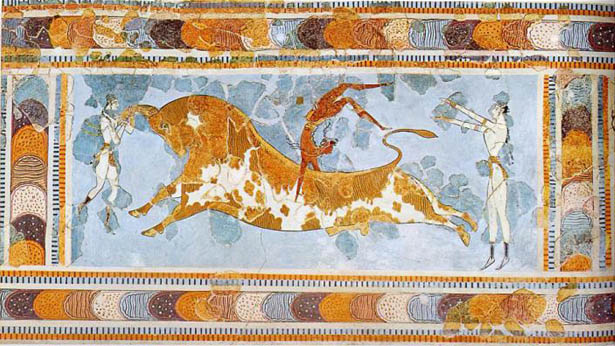
The works of art I will be comparing will be the Bull Leaping from the Minoan culture and the Stele of Amenemhat from the Egyptian culture. Both of these works show similar and different physical properties. I will compare the similarities and differences from both these works of art, mainly focusing on the style, medium, and subject matter.
In terms of style the Bull Leaping shows many similarities to the Stele of Amenemhat. Much like the Egyptians, the Minoans filled their linear contours with bright colors having no indication of shading giving the viewer a more energetic and lively view of colors colliding with each other. Similarly, the Minoans and the Egyptians have used the same mixture of colors. Judging by the scenes the colors could express a feeling of familiarity or of everyday life. Also the Minoan art is similar to the Egyptian in the color the artist chose for the humans depicted on the works of art. The females are depicted as pale white or light skinned giving them a more fair or feminine look. The males are given a dark brown skin color differentiating them from the women giving them a more masculine color.
The Minoan and Egyptian art also depicts the humans similarly, the faces are in profile view and the legs are striding. The difference in the style of the human form would be that the Minoan figure is more flowing and energetic. The humans in the Minoan are showing movement, the man atop the bull has his body bending backwards hinting that he might flip to the women at his right that has her arms out reached ready to take him. While in the Egyptian example, the figures are composited in a rigid manner. The three figures on the left are holding each other, but in a more solid fashion. All the legs of the figures are also very parallel and the scene itself expresses a feeling of conservatism, unlike the Minoan art. The females and males in the Minoan art are dressed less conservatively than the women in the Egyptian art with only simple cloths hiding their pubic areas, while the Egyptian women and men are covered entirely, excluding the female’s breast.
The medium the Minoans chose for their Bull Leaping was wall plaster and the Egyptians chose painted limestone. The type of medium is a little different, but the Egyptians loved to use limestone as their medium, probably because it was abundant around their environment. The Minoans lived on one of the Aegean islands, so they lived at sea giving the artist different ways methods of working with wall plaster; such as painting on a still-wet surface or buon fresco or a dry one (fresco secco). On a still-wet surface the Minoan artist had to work quickly before the wall surface dried and with the dry technique the artist needs to be quick, but the paint would flake off over time.
The Minoans loved to paint in large proportions, especially on wall with scenes of nature or human activity. In the Bull Leaping, the bull is overtaking the entire painting. This emphasizes the bull’s importance to the Minoan culture as the bull is right in the center directing your eyes towards him. The bull was made bolder to signify the Minoan religious legends of that time such as the famous Minotaur that was half man and half bull. The Stele of Amenemhat also includes some of the religious themes such as the food offering on the table to what I could guess, the families gods. The Egyptian piece though, has more of a family oriented symbolism. The family is close together, embracing one another with the men near the center. In the Minoan piece the subject matter seems to be more liberal as the bull is in its bucking position and the human figures around him are filled with energy, working with the bull. Like in the Egyptian piece the male is in the center of the Minoan piece with the bull and the females at the sides, giving the importance of males in Egyptian and Minoan cultures.

