Tuesday, November 29, 2011

My Favorite time periods

            The art I most enjoyed came from the Egyptian period and the Greek. I am very drawn to these periods because Egypt is of great interest to me, specifically its ancient society and culture. The art Egyptians made was so unique as it intergraded many symbols, colors, storytelling, and religious themes. I also like Egyptian art because the gods were so cool looking. There are people that are half human, half animals and the stories surrounding these gods were very creative and fun to learn about. As I mentioned before I also love the Greek Period because realism for the human anatomy was finally realized. I really enjoy looking at the perfection of the human body. The Greek’s had a particular look that every female and male had to look like and I admire it. The need for sculptures to look real as possible generated this aura of intense dynamism. I do admire the sculptures of the Greek Period, but its historical context increased my admiration for the period. I love mythology so the incorporation, like in the Egyptian art, of ancient gods and goddesses drew me to the Greek Period.
            An example of Egyptian art that draws my attention is the Judgment of Hunefer before Osiris. As I mentioned before the incorporation of symbols, mythology, storytelling, and fine detail attracts me and the Judgment of Hunefer before Osiris. To many people who don’t know well into Egyptian mythology the piece may seem interesting that it has an array of colorful figures, but one who does know it has an array of meanings. Such as the eye of Horus, this is meant for good luck, and to have a good life. The Ankh at the top of the piece is the symbol of life, many of the symbols add to the theme and message to the piece. What also drew me in was the placement of all the gods such as Osiris, Isis, Anubis, Horus, Thoth, and Ammit. Hunefer is taken by hand with Anubis through the journey of death to the afterlife and I think the composition of the piece is a nice way of telling a story. Although the colors are little bland and ordinary the placement of the colors compliments the piece.
             For the Greeks I really like The weary Herakles (Farnese Hercules) because simply drawing men is what I am good at, and the Greeks gave a spectacular example of what a god like man should look like. As I’ve said before I love anatomy specifically male anatomy, Ive studied and practiced the art of the male form. Many of my inspirations for the male form come from the Greeks. All the muscles on Herakles are as accurate as they come, from the muscles on thighs to the muscles on the top of the arm. Human perfection was a large theme the Greeks were using I’m assuming because they saw the human body as a beautiful art work within itself. The shadows and on his body work beautifully for the statue. Herakles looks as if he can grab the club he is leaning on and walk off. His stance is of power and calmness. His power is shown from the sheer size of his body and the downward glance Herakles is giving as a sign of domination, but his body language is very calm and relaxed giving the feeling that he is resting.
            Overall I really enjoyed the class, I saw many pieces of art from many periods and learned what inspired art in those times. The Egyptian period and the Greek period were by far my favorite, but I expect that once I come across more periods my admiration for artistic period will increase.

Tuesday, November 15, 2011

Byzantine and Early Medieval Option 1


            As the fall of the Roman Empire was nearing, so was the traditional ways artist’s depicted nature. As society was leaning towards religion, specifically Christianity, artists were influenced by the stories and teachings of the Bible. The two works of art I decided to discuss that depart from naturalism are the Virgin and child with saints and angels on page 245 and Page with Christ washing the feet of his disciples, Aachen gospels of Otto III on page 451.
            On the Virgin and child with saints and angels depth is not shown. There are hardly any indications of shadows, so the details of the faces on the humans look unrealistic. The two saints standing beside the virgin are not foreshortened or shadowed in a way that the viewer cannot tell if the saints are beside in front or behind the chair. The placement of the angels looks awkward and unrealistic, they are colored lighter than the individuals in the front, but no heavy shading indicates they are far away. Baby Jesus sitting delicately on the virgin’s lap is not portrayed as having any weight. The drapery of the virgin’s clothes offer no sense of weight as the baby is seated on her lap. What also seems stylized are the faces, all the faces don’t seem to follow a set of rules in order to make a face. For example, the virgin’s right eye is placed higher and larger than the left eye and the rest of the group’s eyes are abnormally shaped. The saint’s hair looks very simplistic; there is no real indication of texture in the hair. The skin color of the individuals all seem stylized as the saint on the left is shown in a more realistic skin color, while everyone else is colored in a ghostly white. There also seems to be no direction of light as all the lights and darks are mixed.

            In the Page with Christ washing the feet of his disciples, Aachen gospels of Otto III the departure from naturalism is intensified. The stylization of the humans is apparent in the facial expressions and overall anatomy. The eyes seem dead like as there is no white on the eyeballs and show no sign of life in the pupils. The nose is simplified dramatically, only showing a little hint of shadow and some ink coloring. The lips have no fullness to them; they are portrayed small thin with no shadows. The feet and arms are abnormally large, especially the fingers and toes. The architecture in the background is shown with no real depth. The only sense of depth I can see is the use of a focal point of the building. The gold background Christ is in front of has horizontal lines giving an indication that they are stairs and the pillars beside the stairs are not shown in perspective, so it furthers the theme of stylization.
            Both these works of art are far from naturalistic. They both don’t show any perspective, so there is no indication of three dimensional planes. The anatomy of the humans is stylized to a more comical form. My guess as to why these cultures descended from naturalism is the importance of the message than the art. Christianity dominated almost all aspects of life in the Byzantine and Early Medieval era. As the Catholic Church had a firm control on society they pressured many of the artists to emphasize the message and symbolism of the art. 

Tuesday, November 8, 2011

Roman and Early Christian: Option 1

In ancient times power was the factor rulers needed to acquire in order for them to maintain control over their country and people. Rulers such as Commodus and Caracalla did not have commercials to advertise their power, so sculpture and visual art was utilized in order to convey a message of power and control to their country. This type of propaganda was very effective because stone and marble don’t wear out in a short time, the details showed how powerful and real the rulers looked so the people of that time could feel like their ruler was watching them. Also the rulers used sculptures to emphasize their power to strike fear into their enemies or any opposition. The bust of Commodus as Hercules and the portrait head of Caracalla are examples of propagandistic art.
            The bust of Commodus as Hercules exhibits many ideas and symbols. Hercules was an ancient god to the Romans. He was a symbol of power, courage, strength, victory, and good. The statement Commodus is trying to portray is that he is as courageous, powerful, and strong as Hercules. For example Commodus is wearing the lion skin Hercules wore after he defeated a lion. In one hand he is holding a club and in the other the golden apples Hercules sought after in the Garden of Hesperides. Commodus’s vanity is present in the expression of his body. His body is portrayed in a classical view; the marble well smoothed and polished giving his anatomy an impressive depiction of well proportion in his muscles. His face is very peaceful and serene looking, yet he looks firm and confident in his abilities as a ruler. The ringlets in his hair and beard also show that Commodus was very prideful and cared about his appearance. The portrait head of Caracalla also conveys a message of power, courage, and strength. The only difference is Caracalla is portrayed more aggressive and militaristic than Commodus.
 The portrait of Caracalla is shown more masculine and rugged. His features have deep contrast between light and dark giving the portrait a more intense and dynamic facial expression. The details drilled and carved into Caracalla’s portrait are very bold and deliberate. The viewer can see deep set wrinkles on his forehead, cheeks, and the bridge of his nose. Emphasizing these features gives Caracalla a very serious look. The deep engraving of his eyes expresses his determination and his eyes are very deep set dominating everything else on his face, giving him a more brooding mood. His heavy brow accentuates his eyes, giving a darker shadow to his complexion. His short hair and intense gaze gives hints that he was militaristic in his rule. Caracalla was probably trying to convey fear and aggressiveness to his people and enemies. Based on his militaristic look he probably ran his country with an iron fist. He was determined to run his country his way and he did not tolerate disobedience.
            The bust of Commodus as Hercules looked to me more of a piece that was put in a royal court or plaza where many people can see and admire its features and details. Based on Commodus bust, he was probably a man that wasn’t aggressive towards his people. He cared more about materialistic ideas of how rulers should be. The portrait of Caracalla is more portable since it only exhibits his head. This piece could be remade all over the city, so that all the citizens can see that his rule is strong and well grounded. His enemies can also see this and realize he is not a man that will back down. He is determined to conquer and vanquish his enemies at any cost.

Tuesday, November 1, 2011

Option 2 Greek

            Based on the articles I’ve read, I believe it is wrong that the British Museum is holding the Parthenon Marbles all to themselves. I don’t really care that it’s in Britain; my main argument is the British Museum has no right to withhold all the Parthenon Marbles exclusively to their Museum. Lord Elgin toke most of the Parthenon Marbles through legal means by asking the Ottoman Empire in 1799 for permission to take some sketches of the sculptures and some plaster casts of the Parthenon Marbles and some reliefs. A little time after that the Ottoman sultan granted him complete access to the Parthenon and over the years Lord Elgin’s people hacked away most of the Parthenon Marbles. Lord Elgin’s actions may have been legal, but his act of taking away the Parthenon Marbles away from its own birth place is an act of vandalism.
            Although I, and I am certain many people will agree with me that Lord Elgin’s actions were an act of vandalism, it is not a major reason as to why the Parthenon Marbles should be exclusive to the British Museum. Lord Elgin’s actions were in the past, so Greece cannot really penalize Britain for keeping the Parthenon Marbles because Lord Elgin stole them. The British Museum does have a good argument that the smog polluted city of Greece would’ve destroyed the Parthenon Marbles, but now that the Acropolis Museum has been built in Greece to preserve and exhibit the Parthenon Marbles; Greece should have the right and privilege to show the Parthenon Marbles in the Acropolis Museum. Not only do I agree that the Parthenon Marbles should be showed in the Acropolis Museum, but I believe art as culturally significant as the Parthenon Marbles should be shown in Museums around the world. The location of the Parthenon Marbles may have been in Greece, but it doesn’t mean Greece gets to keep the Parthenon Marbles to themselves as well. The Parthenon Marbles were a significant achievement in sculpting and of the human form. The Greek civilization was such a cultural significance globally because of its art, society, culture and government. These aspects of Ancient Greece spread all across the globe, so in a sense, the Parthenon Marbles belongs to no one group or state, it belongs to all human civilization.
             Although I believe that the Parthenon Marbles are exquisite and beautiful to look at, I do think that the British Museum exhibiting the Parthenon Marbles for mainly aesthetic reasons is wrong. Keeping such an important achievement in art for that reason is not justifiable enough to not share the Parthenon Marbles with other Museums. The British Museum, in my opinion, can only keep the Parthenon Marbles for its historical context and to preserve history. So I don’t think the British Museum should keep the Parthenon exclusive to them even if it legally belongs to them. The Parthenon Marbles should be exhibited everywhere around the world, so that many people can have access to view the Marbles and see what a cultural importance they are, especially to Western civilizations.

Wednesday, October 19, 2011

Aegean Art


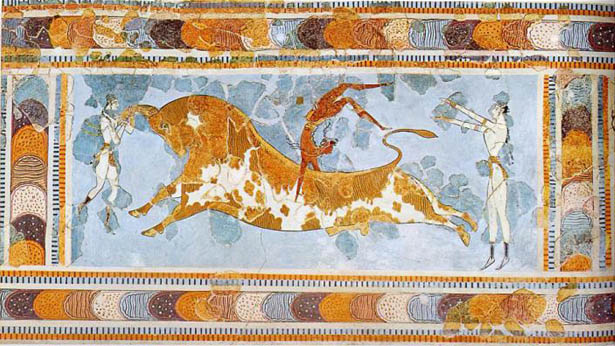
            The works of art I will be comparing will be the Bull Leaping from the Minoan culture and the Stele of Amenemhat from the Egyptian culture. Both of these works show similar and different physical properties. I will compare the similarities and differences from both these works of art, mainly focusing on the style, medium, and subject matter.
            In terms of style the Bull Leaping shows many similarities to the Stele of Amenemhat. Much like the Egyptians, the Minoans filled their linear contours with bright colors having no indication of shading giving the viewer a more energetic and lively view of colors colliding with each other. Similarly, the Minoans and the Egyptians have used the same mixture of colors. Judging by the scenes the colors could express a feeling of familiarity or of everyday life. Also the Minoan art is similar to the Egyptian in the color the artist chose for the humans depicted on the works of art. The females are depicted as pale white or light skinned giving them a more fair or feminine look. The males are given a dark brown skin color differentiating them from the women giving them a more masculine color.
 The Minoan and Egyptian art also depicts the humans similarly, the faces are in profile view and the legs are striding. The difference in the style of the human form would be that the Minoan figure is more flowing and energetic. The humans in the Minoan are showing movement, the man atop the bull has his body bending backwards hinting that he might flip to the women at his right that has her arms out reached ready to take him. While in the Egyptian example, the figures are composited in a rigid manner. The three figures on the left are holding each other, but in a more solid fashion. All the legs of the figures are also very parallel and the scene itself expresses a feeling of conservatism, unlike the Minoan art. The females and males in the Minoan art are dressed less conservatively than the women in the Egyptian art with only simple cloths hiding their pubic areas, while the Egyptian women and men are covered entirely, excluding the female’s breast.
            The medium the Minoans chose for their Bull Leaping was wall plaster and the Egyptians chose painted limestone. The type of medium is a little different, but the Egyptians loved to use limestone as their medium, probably because it was abundant around their environment. The Minoans lived on one of the Aegean islands, so they lived at sea giving the artist different ways methods of working with wall plaster; such as painting on a still-wet surface or buon fresco or a dry one (fresco secco). On a still-wet surface the Minoan artist had to work quickly before the wall surface dried and with the dry technique the artist needs to be quick, but the paint would flake off over time.
            The Minoans loved to paint in large proportions, especially on wall with scenes of nature or human activity. In the Bull Leaping, the bull is overtaking the entire painting. This emphasizes the bull’s importance to the Minoan culture as the bull is right in the center directing your eyes towards him. The bull was made bolder to signify the Minoan religious legends of that time such as the famous Minotaur that was half man and half bull. The Stele of Amenemhat also includes some of the religious themes such as the food offering on the table to what I could guess, the families gods. The Egyptian piece though, has more of a family oriented symbolism. The family is close together, embracing one another with the men near the center. In the Minoan piece the subject matter seems to be more liberal as the bull is in its bucking position and the human figures around him are filled with energy, working with the bull. Like in the Egyptian piece the male is in the center of the Minoan piece with the bull and the females at the sides, giving the importance of males in Egyptian and Minoan cultures. 

Wednesday, October 12, 2011

Ancient Egyptian artistic conventions

            One of the most fascinating civilizations in human history, the Ancient Egyptians had a unique style of artistic convention for their art. Most of it was strict, but it had some minor variations throughout its time. Even though the Egyptians were limited to their conventions, the Egyptians conveyed a unique form of creativity that would spark such an interest in their culture today.
            The Egyptians had a certain type of style they used when it came to their art called Egyptian Pictorial Relief. The way the Egyptians composited their scenes were very similar to the Near Eastern cultures such as the Sumerians. Most of the scenes of the human form were shown in profile composite view with multiple viewpoints. The heads were shown in profile view clearly showing the nose, forehead, and chin. The eyes though were shown in a frontal view to show its most expressive viewpoint. The hips, legs, and feet are also rendered in profile with the legs apart giving the impression that the person is walking and the torso is in full frontal view. The proportions of the humans would be drawn on a mathematical grid; the length of the human from head to toe is 18 squares long, the knees at the sixth square from the bottom, the shoulders are at the sixteenth square and would be sixth squares wide. Lesser social rank persons would be posed in more life-like poses.
            Although the Ancient Egyptians were limited in their stylization of art, their utilization of the physical properties of art conveyed a unique style of creativity. The idea of creativity in art is an attitude a person or groups of person have towards an idea, thought, event or basically something or someone significant enough that a person wants to express on a medium whether it be paper or a side of a rock. I believe the Egyptians were one of the most creative artists in human history. To the Egyptians creativity was expressed by the heavy influence of their religious culture and hierarchy.
Many of the reliefs had scenes of everyday life such as farming, and farming. Reliefs also depicted the power and rule of a Pharaoh, sacred rituals, and the duties and life of the Egyptians gods. The registers were in a two dimensional format, but there was a sense of third dimensionality by the carved forms and incised inscriptions underneath the paint. Speaking of paint, color was used heavily the Egyptian art. Unlike the Near Eastern reliefs and stone-medium art, the Egyptians often used color to emphasize the reaction an artist wanted the viewer to attain. Until the 18th dynasty the only colors used in Egyptian art was black, white, red, yellow, blue, and green. The unique mathematical proportions the Egyptians used to image their human and a god’s form were not the norm, so it employs the viewer to analyze the art. The poses are very strict, but there is a certain energy that flows through the scene as many people are in a line.
Limited to their specific artistic convention, the Egyptians worked their creativity within their mediums. It was probable that creativity wasn’t as relevant as the message the artist was trying to convey, but it came at a close second. The Egyptians used size or scale to determine power and a hierarchy of beings. The composition of a scene would focus on the most powerful being in the register usually in front of a bold background showing a god-like presence. The lines in the art would repeat in patterns giving the piece a harmonic or rhythmic energy.
The Egyptians cleverly used their artistic conventions they had to put out the creativity they craved. Ancient Egyptian art does not need to be a manifestation of creativity in order to be valued today because our level of creativity is not in the same realm as theirs. This does not say that our current art is better or more creative, but only states that the Egyptians utilized what they had to be creative, such as the features of the humans, their proportions, color, line, and composition. 

Tuesday, October 4, 2011

Ancient Near Eastern Art


    The Stele of Naram-Sin is an example of Sumerian art from the Ancient Near East. The Stele or upright stone slab depicts a scene with many human figures involved in what seems to be a battle. Although the stele shows the scene in a rather rigid manner, the overall composition of the figures and detail in the figures suggest a sense of power and action.
            The composition of the figures fills the entire stele; in doing this the artist may have wanted the upmost attention from the viewer to this slab of stone. On the bottom half of the stele a lot of action is taking place. The figures are depicted with their legs spread giving the viewer the impression that they are walking. The rows of what seem to be soldiers are walking in a slanted direction indicating the soldiers are walking up a hill. On top of the stele is a much larger figure than the rest. He is alone in his background indicating that he is a more significant being than the lower figures. At the most top of the slab a series of suns are depicted casting a ray upon the figures below. The suns at the top could signify the skies where the gods of the figures dwell. This composition of the stars, the large ruler, and the soldiers beneath him show a sense of power. The soldiers are at foot level with the ruler showing how powerful and regal he is. The ruler is placed right in the middle of the stele indicating he is the most important powerful figure in the scene. The only thing more powerful than he is the suns in the sky, but the stele is signaling the viewer that even though the suns are above the ruler, the ruler is the one most revered for the importance of the scene. Power is emanating from the stele, the action of the soldiers marching up the hill provides insight as to what is happening.
            Not only does the composition of the figures signify power and action, but the details of the slab indicate it as well. At the top the suns are shown with rays of light coming from within the suns, this shows action because it shows that the suns are shining and could mean it is daylight. The ruler is seen in a glorified and powerful pose, he is holding his array of weapons signifying his power of all others as the rest of the figures only have one or two weapons. The ruler’s headgear also signifies power as it is the only one with horns, while the rest of the figures have simple headgear. The horns could represent godhood or royalty either way this indicates power. All the figures below the ruler are all tilting their heads upward in the ruler’s general direction showing they recognize his rule and distinguish that the ruler is above them. Under the left foot of the ruler there is a mass of bodies indicating that the bodies are the enemy, so they are inferior to the ruler. The figures on the right of the ruler portray an image of weakness because the ruler is much larger than they are and the actions the figures engage in conclude this assumption. The figure right of the ruler has stabbed himself and the figures behind and below him have their hands upward in a clasped manner giving the impression that they are pleading for mercy. They are at the ruler’s disposal as his proud and powerful pose crushes his opponents.
            The Stele of Naram-Sin portrays the energy of power and action in all kinds of ways. The composition of the figures shows the hierarchy of the scene giving the viewer a forceful and direct image of power; and the details within the stele further embody power as the actions are deliberate and bold. Given the use of a stone slab, which is strong, hard, and solid, the art carved on the slab blends well with the overall effect of the piece.

Wednesday, September 28, 2011

Venus of Willendorf

            The article “The Woman of Willendorf” I learned many things from such a small special piece of art. From its discovery it has gained a surge of popularity not only for its rarity, but for the evidence it brings about our ancestors creativity and culture. The Venus of Willendorf’s proportions bring about a lot of controversial issues about femininity and sexuality, her name has stirred controversy as to why name her such a name thought only in Greek or Roman connotations, and does the Venus of Willendorf change the definition of what beauty is.
            The contemporary issues that are brought up when looking at such an art piece of the Venus of Willendorf are femininity and sexuality. The way the artist chose the specific proportions for the statuette profoundly touch upon the ideas of how we viewed femininity. The statuette style of appearance shows the viewer that she is not afraid of showing her body. It seems she is proud of her curves and overly proportioned attributes such as the breasts, stomach, and buttocks. Based on the article, it argues that femininity was a male construction of a women having  a slender body, hiding her body in a civilized manner, and all proportions of her body hips, legs, breasts, vulva have no emphasis. The Venus of Willendorf does not meet any of the Roman or Greek (or the Western world) standards of femininity. She is unrestraint in her posture; she shows no inhibition to hide her sexuality. Her bold action to show her sexuality brings about uneasiness to today’s society of what female power can reach. Women are supposed to be controlled, tamed, and purposed only for a male’s pleasure. The Venus of Willendorf breaks this idea and gives our current generation ideas of how women should actually live.
            Not only does her roundness attract you, but the name given to her also leaves you pondering of why the name “Venus”, given that histories profile of the goddess Venus, is of a beautiful, sexually civilized, heterosexual male attracting woman. In the article it states that the original founders gave her the name Venus as an ironic joke for patriarchal society’s sake. It may be true, but it also questions of what could also be the reason as to her name. Do you have to have the physical traits of what the Romans and Greeks idealized for a female or can you be what you truly want to be. Not necessarily being naked for all to see, but being naked in your feelings, femininity, sexuality, and power. Being proud of your attributes instead of hiding them because male dominated society feels you should be ashamed. By naming the statuette a name considered to be the goddess of love and beauty it changes the foundations of what love and beauty is.
            The Venus of Willendorf’s in the round style directs you to see all her body, her plump curves are nicely shadowed, smooth and her details are precise. The artist had intention to mold her this way for some reason unknown to anyone. To some the small statuette may seem visually unpleasant because of our current societies views on beauty, but her unpleasantness can actually be beauty. She may not be a perfect model for today’s runway, but she is beautiful in her quality of her details. Her open sexuality brings about an aura of power that could interpret that the Venus of Willendorf feels empowered, free, unafraid of what she represents and who she is. Today’s beauty focuses more on the outside physical beauty, but what needs to be focused more is internal beauty. Physical beauty can erode and erase, but emotional, intellectual, and spiritual beauty are eternal. The Venus of Willendorf is a good representative on what beauty should be.
            The Venus of Willendorf breaks barriers of society, culture, and feminism. The style the artist approached to achieve her attributes was thought provoking. The nature of her posture brought upon controversial issues of femininity and sexuality, her name has changed what the Romans and Greeks perceived of what Venus should look and act like, and the composition of the statuette changes what our current society perceives as beauty. The Venus of Willendorf may be ancient, but it still invokes ideas that are influential today.

Wednesday, September 21, 2011

Introductory Post

I am a Junior at Central and I plan to major in Art and minor in Philosophy. Im majoring in art because its something that Ive done all of my life and I love doing it. I dont know what I plan to do with it, but its something that makes me happy. I particularly love penciling, inking, and charcoal. I mostly draw comic book type of art, but I am versatile. I want to minor in philosophy because I love thinking about difficult questions that cant be answered simply; I enjoy making my own theories about life, religion, culture, society, science, and other subjects. My hobbies are drawing (of course), watching films (spaghetti westerns, 80's action, psychological thrillers, horror, science fiction) , listening to music (electronic, synth-pop, alternative rock, dance, techno), video gaming (fighter, 3rd person shooter, arcade), hiking, swimming,  running, reading comic books, and other stuff I cant remember.